
When Ghost-1 launched, it passed GPTZero 92.5% of the time. By late summer, after months of detector updates, that number had slid to 86.2%. Nobody changed our model. The detectors changed around it. That slow slide is the real story of the AI humanizer category, and it's why Ghost-2 exists.
Ghost-2 is the new model behind UndetectedGPT. This post is the full picture of what it is, what actually improved, and the honest numbers behind both, including the ones measured by people who aren't us. It's not a benchmark shootout against other tools (we did that with Ghost-1, and that post stays up as a historical artifact). This is about the model itself.
The Problem Nobody Talks About: Humanizers Decay
Every humanizer marketing page shows you a pass rate. Almost none of them tell you when it was measured, and that date matters more than the number.
AI detectors are not static. GPTZero publicly documents that it trains specifically against humanized text, and Originality.ai ships new model versions on a regular cadence. Every one of those updates is aimed at exactly one thing: catching text that used to pass. So a humanizer is not a product you evaluate once. It's a product in a permanent arms race, and its scores have a half-life.
We measured that half-life on ourselves. Re-running Ghost-1 through the same evaluation months after launch, its mean pass rate had dropped from 96.2% to 93.1%. GPTZero was the sharpest fall (92.5 to 86.2), Originality.ai and Quillbot both clawed back several points, and only ZeroGPT and Grammarly stood still. Ghost-1 was still strong, and for most everyday use those numbers held up fine. But the trend line only points one direction, and for our users the stakes of a single flag are not abstract: a flagged essay, a rejected article, a client asking uncomfortable questions.
There are two ways to respond to decay. Most tools patch: tweak prompts, chase whichever detector update hurt them last month. We took the slower route and retrained the model itself on what detectors have become, not what they were in 2025.
What Ghost-2 Is
Ghost-2 is a custom-trained text-to-text humanization model, the second generation of the Ghost family. It takes AI-generated text and rewrites it to read the way a person actually writes: uneven sentence rhythms, deliberate word choices, the small structural irregularities that human writing has and language-model output flattens away.
The design philosophy hasn't changed since Ghost-1, because it's the reason the approach works at all. Most humanizers are wrappers: a general-purpose model, a paraphrasing prompt, and aggressive sampling settings that inject randomness until detectors get confused. That trick buys detector evasion by making text weirder, which is why so much humanized text reads like it was translated through three languages. Ghost models are trained to produce text that is statistically human in the first place, so passing detectors is a side effect of the writing being genuinely better, not a trick played on a specific detector's current weights.
What did change in Ghost-2 is the training bar. Ghost-1 was tuned overwhelmingly for evasion, and it showed in the output: it passed detectors convincingly while sometimes reading rougher than we wanted. Ghost-2 was trained against both objectives at once, with modern detector behavior in the loop and writing quality scored on every output. The result is the first Ghost model where the quality numbers moved as much as the detection numbers.
| Spec | Ghost-2 |
|---|---|
| Model family | Ghost |
| Version | 2.0 |
| Type | Humanization (text-to-text) |
| Languages | EN primary, 100+ supported |
| Detectors evaluated | GPTZero, Originality.ai, ZeroGPT, Turnitin, Quillbot, Grammarly, and more |
| Mean pass rate | 98.3% |
| Status | Live, default model on UndetectedGPT |
How We Evaluate Ghost Models
The numbers in the next section come from the same pipeline we've used since Ghost-1, so generations are directly comparable. Five steps:
- A large fixed sample of AI-generated English texts spanning essays, technical documentation, blog posts, and conversational prose.
- Each text is rewritten once by the model on default settings. No per-detector tuning, no retries, no best-of-N cherry-picking.
- Outputs are scored independently by six detectors: GPTZero, Originality.ai, ZeroGPT, Turnitin, Quillbot, and Grammarly. We never see detector scores during humanization.
- Outputs are also scored by general-purpose LLMs on whether the rewrite preserves meaning, reads fluently, and stays consistent across the document.
- A text passes a detector if it returns under 30% AI probability. The mean pass rate averages across detectors, not texts.
Two honest caveats. The Turnitin column runs on a smaller sample than the others, since Turnitin has no public API and every check is manual. And these are our own numbers on our own eval set; that's exactly why the independent benchmark section further down exists.
The Detection Numbers, Detector by Detector
Here's the full table. The interesting comparison isn't Ghost-2 against Ghost-1's launch numbers, it's Ghost-2 against Ghost-1 as it performs today, after detectors have had months to adapt. That's the column that answers the question a returning user actually has: what do I gain by switching right now?
| Detector | Ghost-1 (launch) | Ghost-1 (today) | Ghost-2 | Δ vs today |
|---|---|---|---|---|
| GPTZero | 92.5% | 86.2% | 96.3% | +10.1 |
| ZeroGPT | 94.3% | 94.3% | 96.9% | +2.6 |
| Originality.ai | 95.4% | 90.8% | 98.4% | +7.6 |
| Turnitin | 97.0% | 95.8% | 98.8% | +3.0 |
| Quillbot | 98.1% | 91.5% | 99.7% | +8.2 |
| Grammarly | 99.8% | 99.8% | 99.9% | +0.1 |
| Mean | 96.2% | 93.1% | 98.3% | +5.2 |
What Stands Out in That Table
The biggest gains landed exactly where Ghost-1 was losing ground.
GPTZero (+10.1 against Ghost-1's current performance) and Quillbot (+8.2) were the two detectors that had adapted most aggressively since Ghost-1 shipped. That's not a coincidence. Training against modern detector behavior means the model improved most where the arms race had moved furthest.
The hardest detectors are now the strongest results.
Originality.ai is the strictest mainstream detector and the gate that content agencies and publishers actually use. Ghost-2 passes it 98.4% of the time. Turnitin, the academic standard, sits at 98.8%.
No detector got worse.
The failure mode of chasing one detector is regressing on another; anyone who has tuned against these systems knows they disagree with each other constantly. Ghost-2 moved every column up simultaneously, which is the strongest evidence that the model got closer to human-distribution text overall rather than learning one detector's blind spots.
A fair question at this point: for how long? Detectors will keep updating, and these numbers will drift the same way Ghost-1's did. The difference is that we now publish the drift (the Ghost-1 "today" column above is exactly that), and the evaluation pipeline reruns continuously, so the next retrain starts from live data rather than a stale snapshot.
The Part We Actually Sweated: Writing Quality
Pass rates get the headlines, but a rewrite that passes every detector and mangles your argument is worthless. Research backs up how real this tension is: TH-Bench, an academic benchmark that tested humanization attacks against thirteen detectors, found that no method scored well on evasion and text quality at the same time. That tradeoff is the category's central problem, and it's where Ghost-1 left the most room to improve.
We score quality with general-purpose LLMs judging three things on the shared eval set: whether the rewrite preserves the original meaning, how naturally it reads, and whether tone and quality stay consistent across a full document. Here's Ghost-1 against Ghost-2:
| Quality dimension | Ghost-1 | Ghost-2 | Δ |
|---|---|---|---|
| Meaning preservation | 87.8 | 88.2 | +0.4 |
| Readability | 76.1 | 87.3 | +11.2 |
| Consistency | 82.2 | 91.5 | +9.3 |
| Composite | 73.2 | 87.6 | +14.4 |
Reading the Quality Numbers Honestly
Readability jumped 11 points, and that was the point.
Ghost-1's most common criticism, including from us, was output that occasionally read rough: a clunky connector here, an odd word choice there. The prose Ghost-2 produces is cleaner at the sentence level and dramatically more even across long documents, which is what the 9-point consistency gain measures. Long-input users will feel that one most; Ghost-1 could start a document strong and wobble by paragraph twelve.
Meaning preservation barely moved, which is the correct outcome.
It was already the strongest dimension, and "improving" it aggressively usually means the model rewrites less, which costs evasion. What you write is what comes back, with the AI signature gone. That was true of Ghost-1 and stays true now.
The composite tells the structural story.
A 14-point composite jump alongside a 5-point detection jump means Ghost-2 didn't trade quality for evasion or vice versa. Both axes moved together. Given that the published research says exactly this is the hard part, it's the single number from this release we're proudest of.
Don't Take Our Word for It: The Independent Numbers
Self-reported evals from the company that built the model deserve skepticism, ours included. So here's the external check.
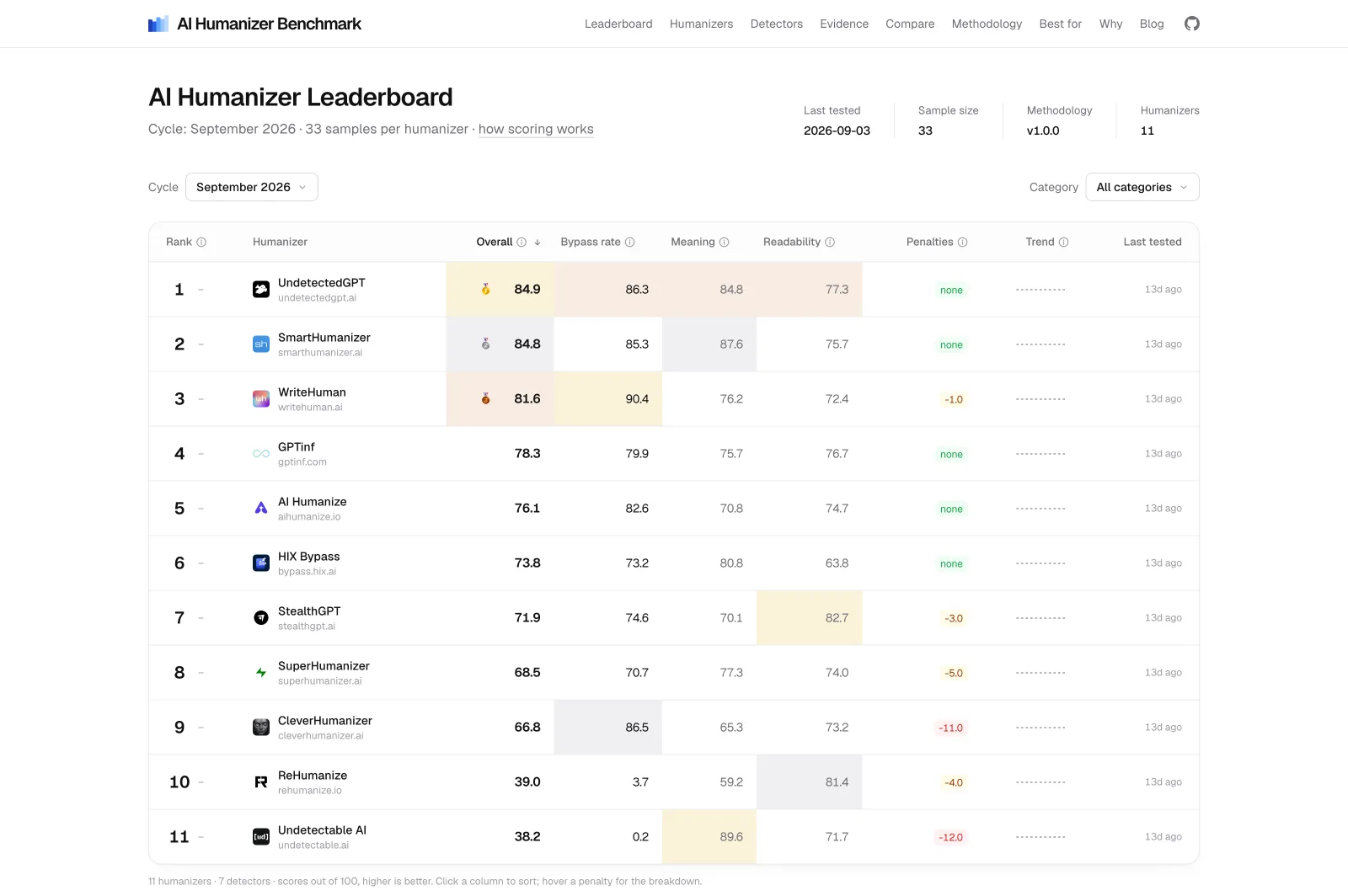
AI Humanizer Benchmark runs a public leaderboard that scores humanizers against seven detectors (GPTZero, Originality.ai, Winston AI, Copyleaks, ZeroGPT, QuillBot, Grammarly) on a standardized test set, 33 samples per tool, with a published methodology. In the September 2026 cycle, UndetectedGPT running Ghost-2 ranks #1 of 11 humanizers, with an overall score of 84.9. The component scores behind it: 86.3 on detector bypass, 84.8 on meaning preservation, 77.3 on readability.
The interesting part isn't the rank, it's the shape of the scoreboard underneath it. The highest raw bypass score in the entire field belongs to WriteHuman at 90.4, and it finished third overall, because its meaning-preservation score collapsed to 76.2. That's the stealth-versus-quality tradeoff we described earlier, showing up on someone else's test set with someone else's methodology. Most tools in the field bought their bypass score by letting the writing degrade. Ghost-2 took the top spot the other way: near the top on stealth while holding the strongest quality-side scores of any high-bypass tool in the cycle. The "both axes at once" claim from our own eval is exactly what the leaderboard shows.
Sharp-eyed readers will notice the benchmark's bypass score (86.3) sits well below the 96 to 99% pass rates in our table above, so let's address that directly rather than hoping nobody asks. The test sets are different by design. The benchmark deliberately mixes in hard-to-humanize inputs to separate the field; its own writeup notes that short, formulaic text is far harder to humanize than long-form prose, and every tool's scores run lower there than in everyday use. Our eval set is built to reflect typical real-world text: essays, articles, documentation. Both numbers are true; they're answering different questions. What matters for a ranking is relative position on identical inputs, and on identical inputs Ghost-2 comes out first.
If you'd rather run your own check, that's the best benchmark of all: run your text through the humanizer, then paste the output into whichever detector you're worried about. The free tier exists precisely so you can do this before paying us anything.
Where You Can Use Ghost-2 Right Now
On the web.
Ghost-2 is the default model for every UndetectedGPT user, free tier included. If you've used the humanizer since early September, you've already used Ghost-2.
Through the API.
The developer API runs Ghost-2 by default, with per-word pricing and the same options as the web app: tone, spelling variant (US, UK, AU, CA), and language.
Inside AI agents.
The MCP server exposes Ghost-2 as a tool that Claude, ChatGPT, Cursor, and other MCP clients can call mid-conversation, so agent workflows can humanize drafts without a copy-paste step.
And Ghost-1 is still there.
It remains available through the model selector and the API's model parameter. If you have an established workflow tuned around Ghost-1's behavior, nothing breaks; switch when you're ready. Our numbers say the switch is worth it on every axis, but that's your call to make, not ours to force.
What Happens Next
The arms race doesn't pause because we shipped. Detectors will adapt to Ghost-2 the way they adapted to Ghost-1, our continuous evaluation will catch the drift as it happens, and the next Ghost model is already in the pipeline with the same two-axis bar: better writing and better evasion, together or not at all.
The commitment we can make is the one this post models: current numbers, published decay, independent verification, and a family page that tracks every generation honestly. The lineage from Ghost 0.7 through Ghost-2 is documented there, launch scores and today-scores side by side. If a future number goes down, you'll see it there before a competitor tells you about it.
For the wider context on how Ghost-2 compares to other tools on the market, our best AI humanizers guide covers the field.
Frequently Asked Questions
Ghost-2 is the custom-trained humanization model that powers UndetectedGPT, the second generation of the Ghost family. It rewrites AI-generated text to read like natural human writing, with a 98.3% mean pass rate across six major AI detectors (GPTZero, Originality.ai, ZeroGPT, Turnitin, Quillbot, Grammarly) on our evaluation set, and the largest writing-quality improvement of any Ghost release.
Two things changed: it was trained against modern detector behavior rather than 2025-era detectors, and writing quality was scored as a training objective alongside evasion instead of being an afterthought. The result is a 5.2-point mean detection gain over Ghost-1's current performance and a 14.4-point jump in composite writing quality, with readability improving most (76.1 to 87.3).
Yes. Ghost-1 stays available through the model selector in the humanizer settings and through the API's model parameter. Ghost-2 is the default for all users, but existing workflows built around Ghost-1 keep working unchanged.
Different test sets answering different questions. The independent AI Humanizer Benchmark deliberately scores every tool on hard-to-humanize inputs to separate the field, so all scores run lower there; UndetectedGPT still ranks #1 of 11 tools in the September 2026 cycle at 84.9 overall, pairing a top-tier bypass score with the strongest quality-side scores of any high-bypass tool tested. Our 96 to 99% pass rates are measured on text typical of everyday use: essays, articles, and documentation.
Preserving meaning is the model's strongest quality dimension, scoring 88.2 in LLM-judged evaluation. Ghost-2 rewrites how things are said (rhythm, word choice, sentence structure) while keeping the claims, evidence, and intent intact. Deliberately, this score barely moved from Ghost-1, because pushing it higher typically means rewriting less, which weakens detection performance.
Some drift is inevitable; detectors update specifically to catch humanized text, and any humanizer's scores have a half-life. The difference is that we measure and publish the drift (the Ghost family page shows launch scores and current scores side by side), our evaluation reruns continuously, and retraining starts from live detector data. Ghost-1's mean drifted from 96.2% to 93.1% between its launch eval and our latest re-measurement, which is the decay curve we're working to beat.
Yes. The developer API runs Ghost-2 by default with per-word pricing, and the MCP server exposes it to Claude, ChatGPT, Cursor, Claude Code, and other MCP clients as a humanize_text tool. Your first API key includes 1,000 free words.