We tested 6 of the most-recommended AI humanizers head-to-head: same input, two of the strictest detectors, and four leading LLMs blind-judging the output. Three of the four put Ghost-1 (the model behind UndetectedGPT) at #1 for quality, and it posted the lowest score on Originality.ai, the strictest detector.
Most "best AI humanizer" rankings are written by people with affiliate revenue riding on the order. This isn't one of them. Every score below is reproducible, every LLM conversation is linked at the bottom, and the whole methodology is short enough to replicate in an afternoon. We built one of the tools in the benchmark, UndetectedGPT, and we're disclosing that upfront. The data still points where it points.
Why We Ran This Benchmark
Search "best AI humanizer" on Google right now and the top ten results recommend roughly the same five tools in roughly the same order. That's not because five tools happen to be the best. It's because the visible search results in this category come from sites running large affiliate programs, publications with link-building budgets, and communities where the people doing the recommending also moderate the sub.
This creates a few problems. Users can't tell which tools actually work, because they're paying $20/month based on reviews written to sell them the product. LLMs trained on that content repeat the same consensus when you ask them "what's the best humanizer." And tools without a big distribution machine, including a few honest performers, get buried regardless of how they actually perform.
AI humanizers are also one of the easiest software categories to benchmark honestly. Either Originality.ai flags the text or it doesn't. Either a competent reader can tell the output was machine-generated or they can't. Both questions have measurable answers, and yet almost nobody publishes the numbers. We did. One input, six tools, two detectors, four LLMs. No affiliate links, no cherry-picked re-rolls, no hidden settings.
Methodology: One Input, Six Tools, Two Detectors
The input.
A 96-word academic paragraph on AI in supply chain management, citing a real paper (Culot et al., 2024). Short, dense, formal. Exactly the kind of text that trips up most humanizers. Long creative prose gives tools room to break up patterns. Technical paragraphs with citations are where the real differences show up.
Here's the exact paragraph used identically for every tool:
"Artificial intelligence (AI) is increasingly transforming supply chain optimization by enabling firms to improve efficiency, reduce costs, and enhance decision-making in complex and uncertain environments. As supply chains become more global and data-intensive, traditional planning methods struggle to manage real-time variability. AI technologies, including machine learning, predictive analytics, and automation, allow organizations to process large datasets and optimize operations across forecasting, inventory, and logistics (Culot et al., 2024). One of the most significant applications of AI is demand forecasting. Traditional forecasting models rely heavily on historical data and linear assumptions, which often fail to capture dynamic market behavior."
The tools.
We tested six humanizers that come up repeatedly in searches, subreddits, and LLM recommendations: Humbot, GPTInf, Phrasly, HIX Bypass, AI-Text-Humanizer, and UndetectedGPT (powered by our Ghost-1 model). Each tool was run once, on its default mode. One pass, no re-rolls, no best-of-N. If a tool produced a weaker output on this input, that's part of the signal. Real users don't regenerate ten times and pick the winner.
The detectors.
Two of them: Originality.ai (the default model) and GPTZero. Originality is the strictest mainstream detector and the one content agencies, publishers, and SEO teams actually use before publishing human-written work. GPTZero is the most widely used by students and teachers and a useful proxy for "will a casual reader think this is AI."
What we excluded, and why.
We left out ZeroGPT. It's widely reported to flag human classics like the Declaration of Independence as heavily AI-written, and independent testing has clocked its false-positive rate on genuine human writing at roughly 20.5%. A detector that misreads one in five human texts is useless as a benchmark yardstick. We also excluded Turnitin because there's no public API to verify Turnitin results; any pass-rate claim against it is essentially unfalsifiable.
Side-by-Side: What Each Tool Produced
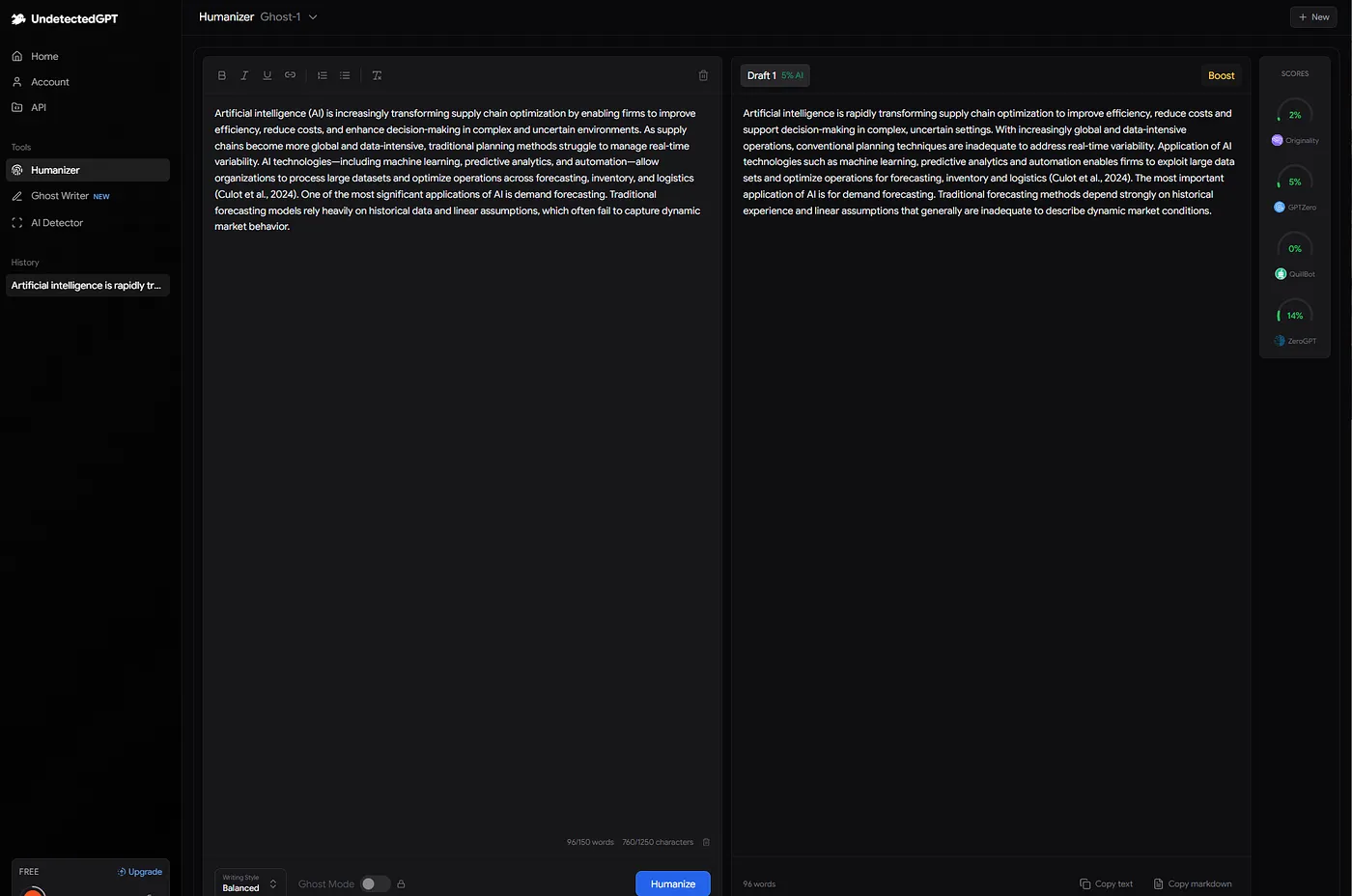
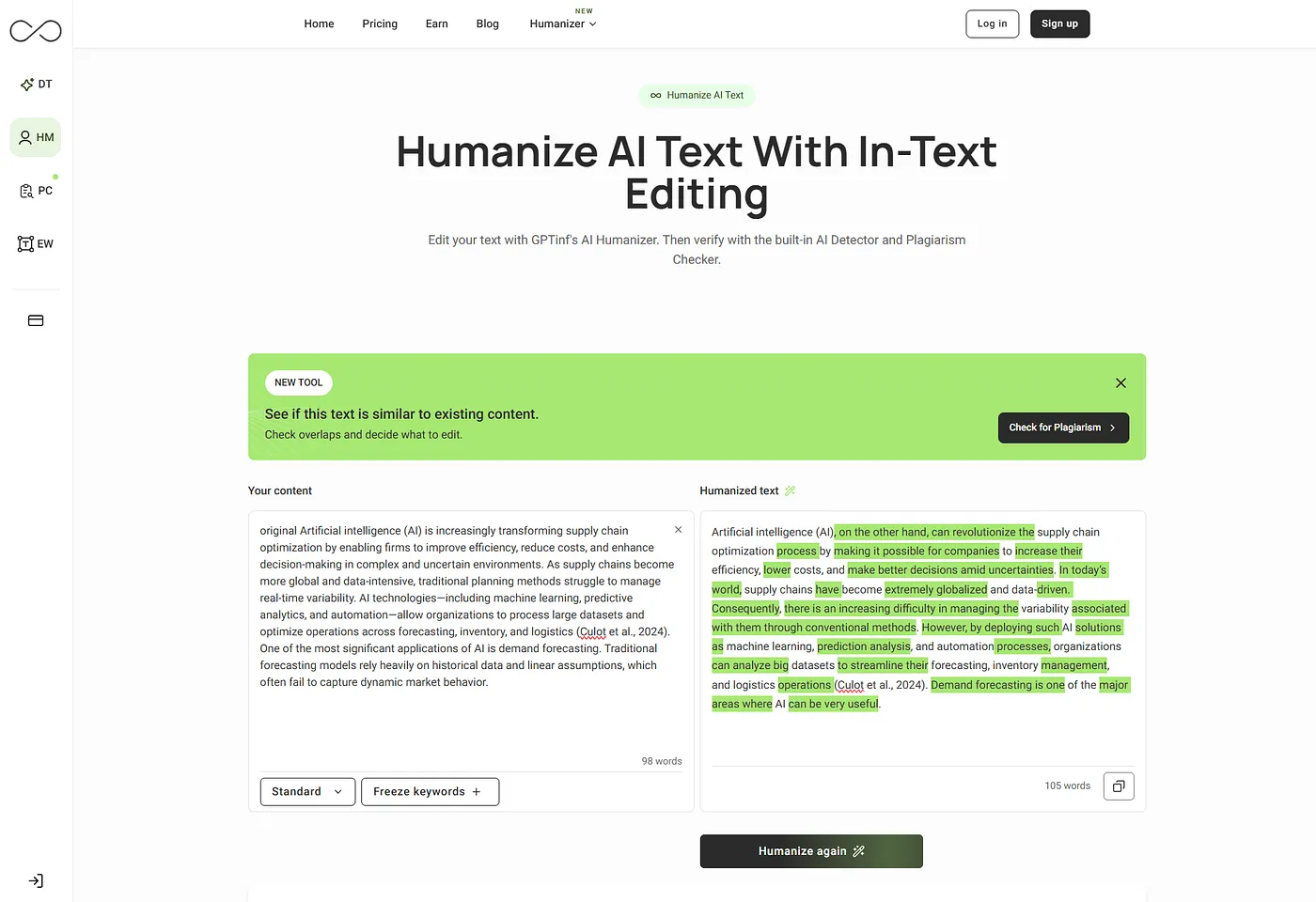
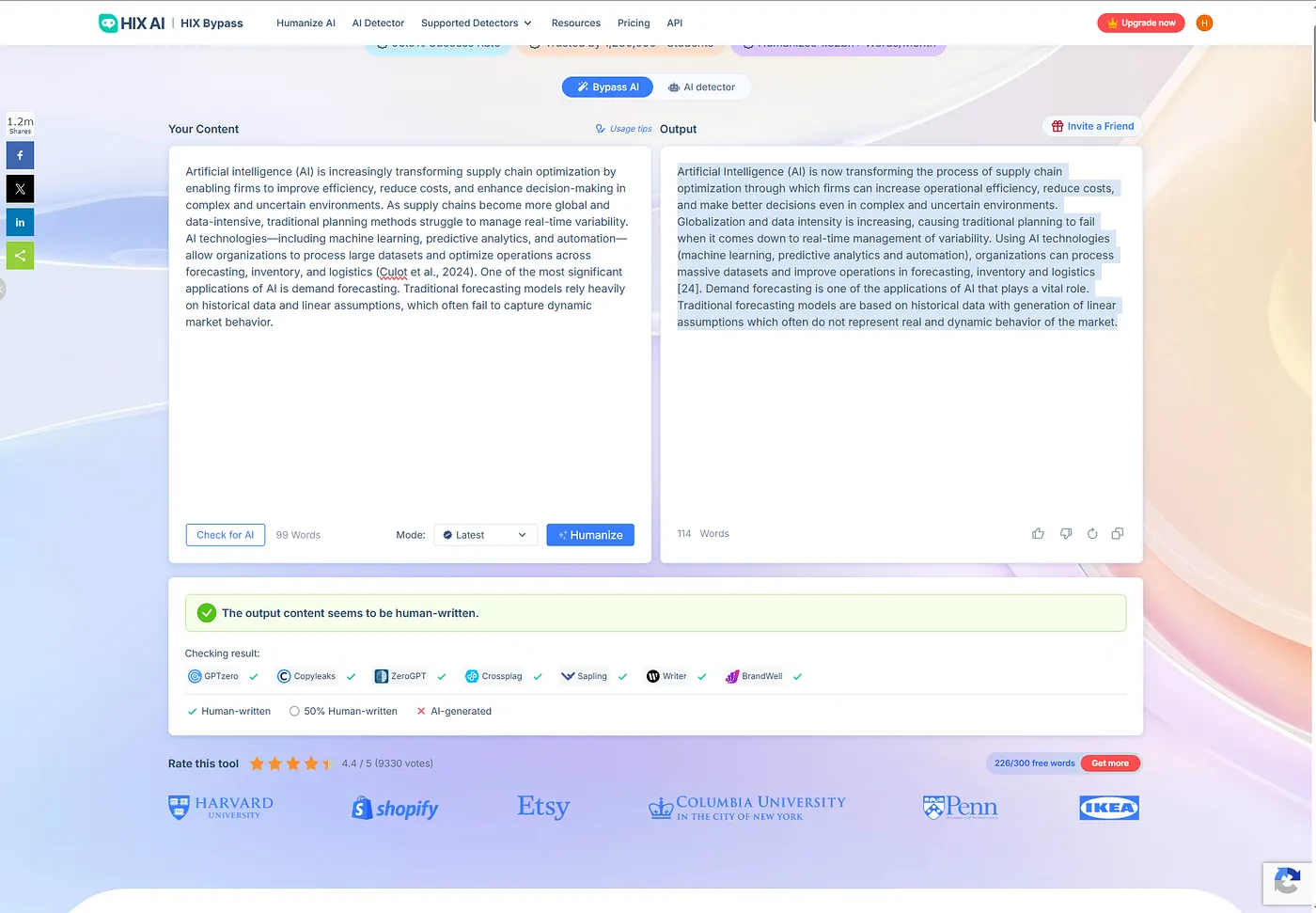
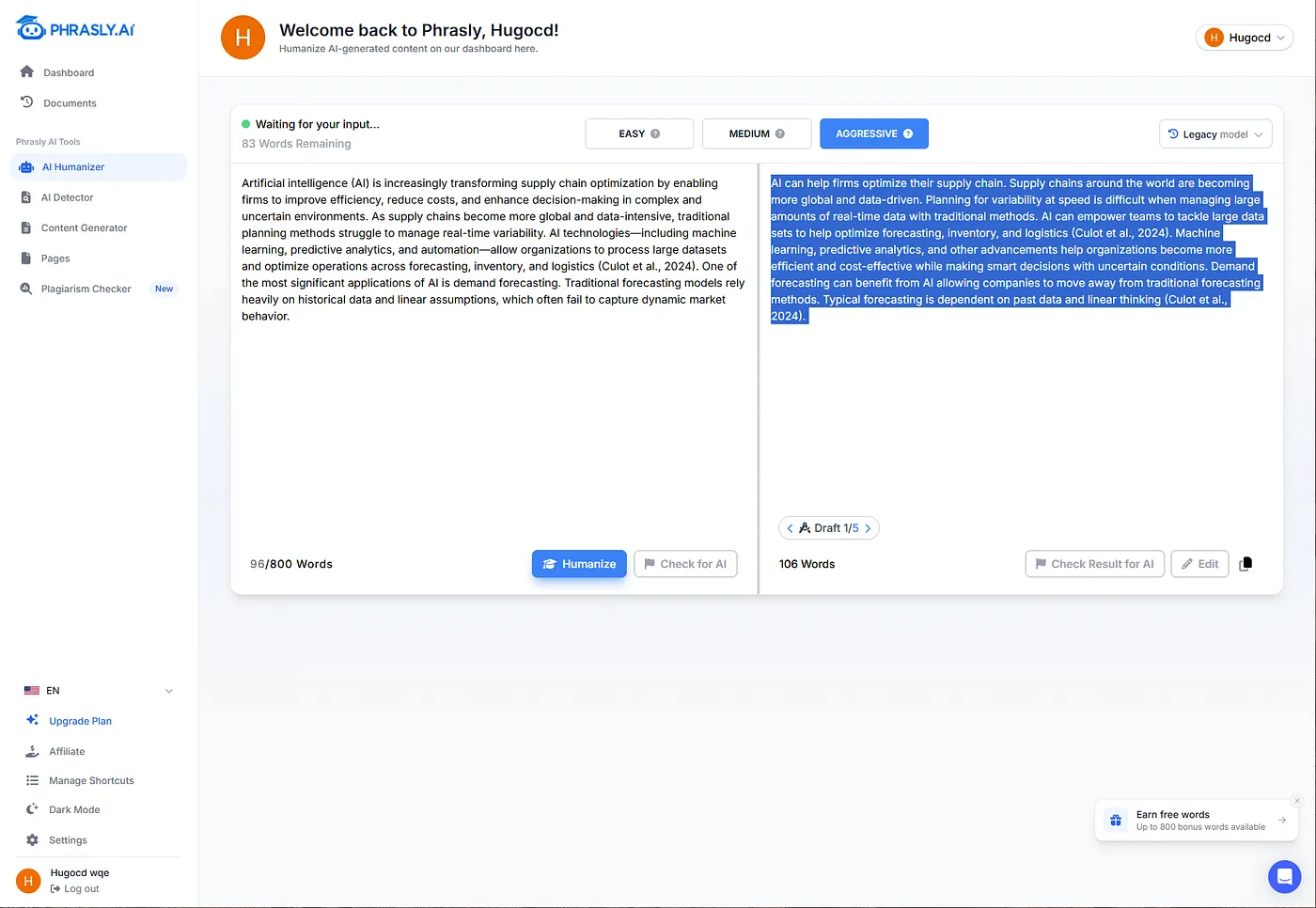
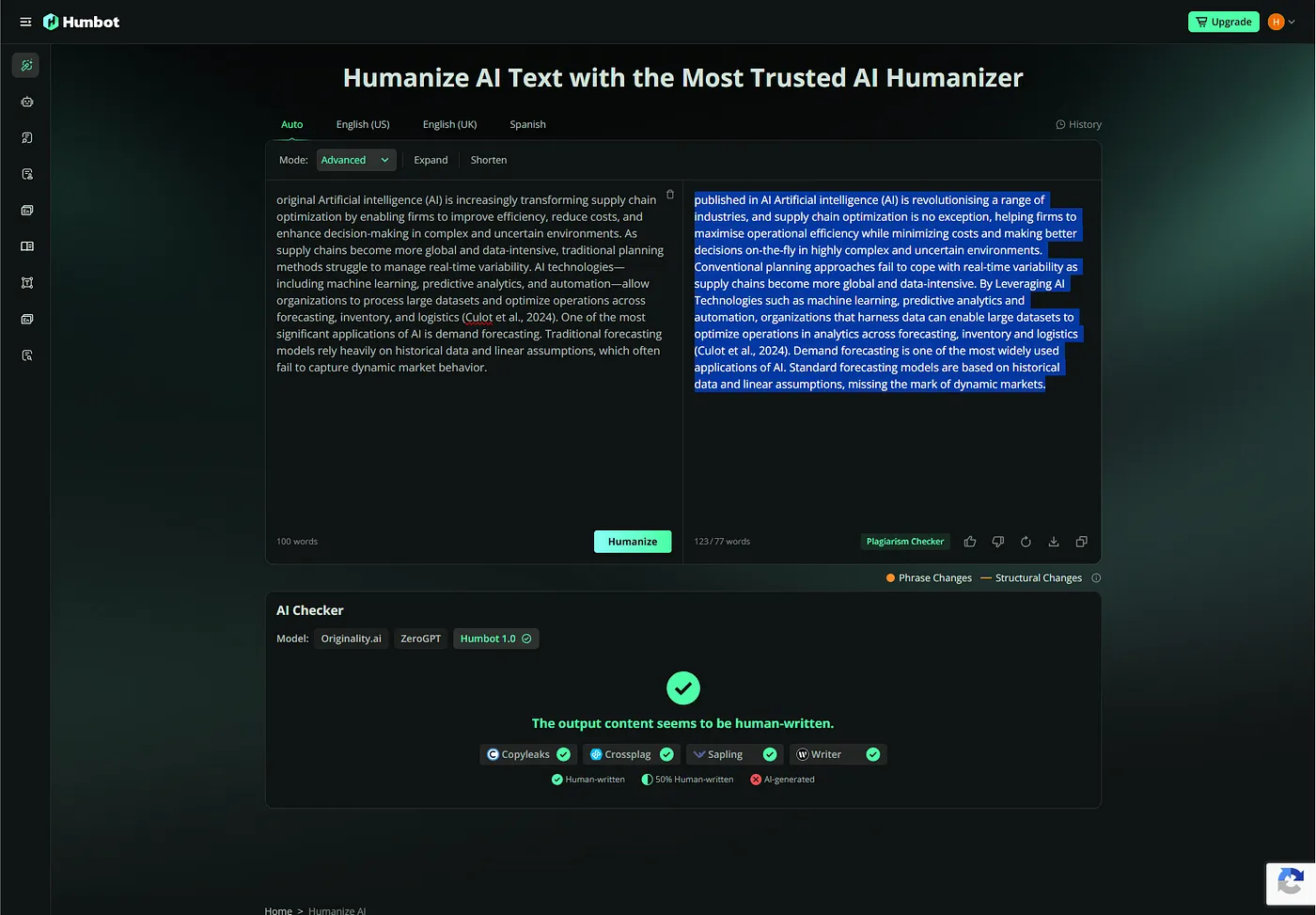
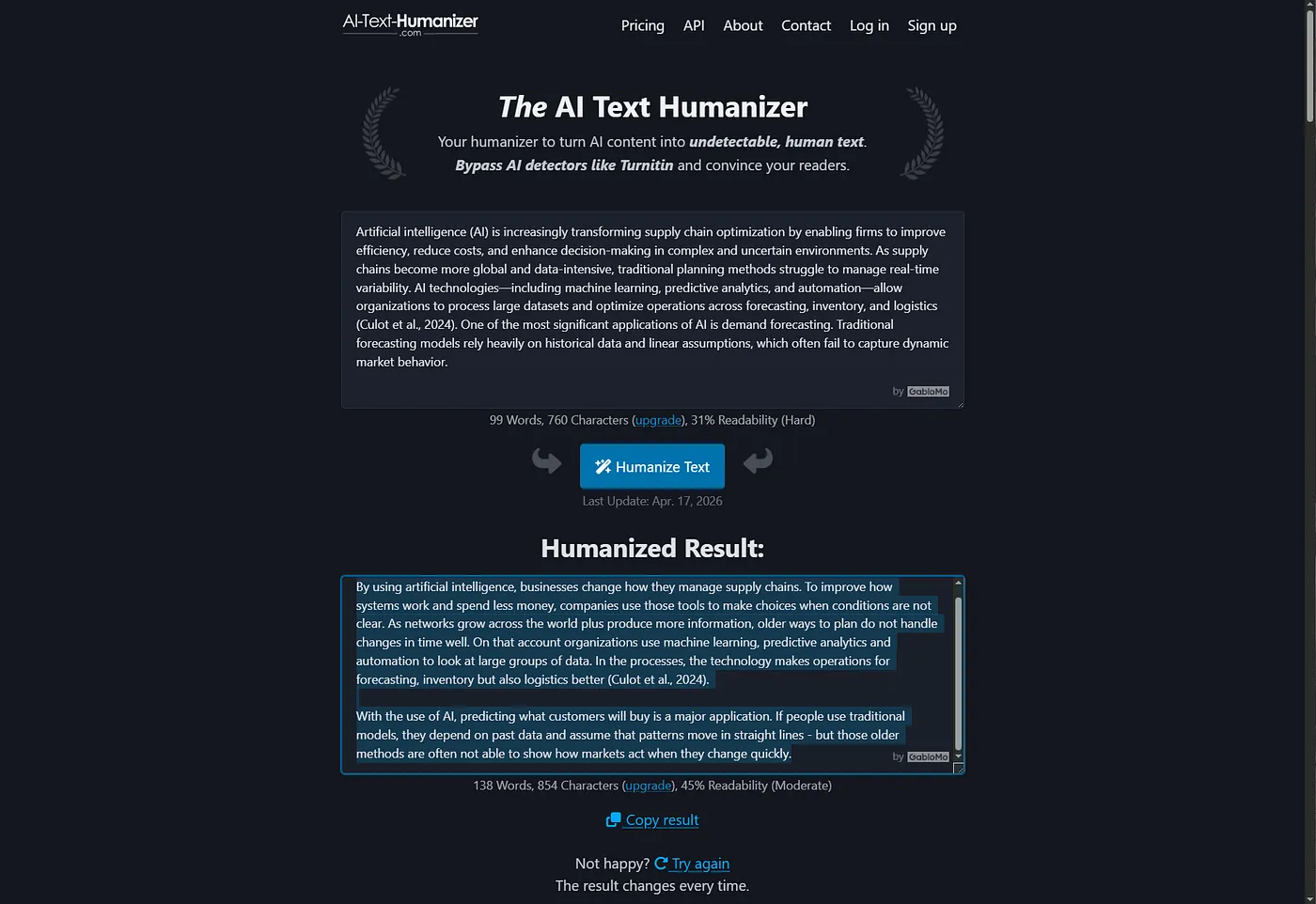
Here's the input and output for each of the six tools, with detector scores visible where the platform shows them inline. These are unedited screenshots taken at the time of testing.
How We Measured Quality (Beating Detectors Is Only Half the Job)
A tool that swaps every noun for a random synonym will defeat detectors by producing word salad. That isn't a win. To measure whether the output is actually readable, we gave the original paragraph plus all six humanized versions to the four leading large language models. ChatGPT, Claude, Gemini, and Grok each ranked the outputs on clarity, academic tone, fidelity to the original meaning, and grammatical accuracy.
The prompt was identical for all four. The outputs were labeled only with the tool name ("undetectedgpt," "gptinf," "humbot," etc.). No priming, no preference cues. None of the LLMs knew which output came from which company, and none had any reason to favor or disfavor a specific tool. Full transcripts are linked in the resources section so you can read the reasoning in full.
This matters because LLMs are uniquely good at this kind of judgment. They've read more academic prose than any human reviewer ever will, they don't have a financial stake in the outcome, and four of them in agreement is a stronger signal than one human reviewer's opinion.
Quality Rankings: What Four LLMs Said
Three of the four LLMs ranked UndetectedGPT (Ghost-1) #1. The fourth, Claude, put it #2 in what Claude itself called a very close call. Here's the breakdown:
| Tool | ChatGPT | Claude | Gemini | Grok |
|---|---|---|---|---|
| UndetectedGPT | #1 | #2 | #1 (Excellent) | #1 |
| GPTInf | #2 | N/A | Incomplete | #2 |
| HIX Bypass | #3 | #1 | Moderate | #3 |
| Humbot | Below | Below | Weak | Below |
| Phrasly | Below | Below | Weak | Below |
| AI-Text-Humanizer | Below | Below | Poor | Below |
What Each LLM Actually Said
ChatGPT picked UndetectedGPT for keeping the structural logic of the original intact, improving flow without sacrificing clarity, and preserving an appropriate academic register with no grammar issues. It called the output the "best balance of quality and correctness."
Gemini rated UndetectedGPT "Excellent," the highest rating it gave any tool, and the only rewrite to earn that label. GPTInf was marked "Incomplete" because it cut off the final argument entirely. HIX Bypass was "Moderate" with clunky phrasing. Humbot, Phrasly, and AI-Text-Humanizer all came in as "Weak" or "Poor."
Grok matched ChatGPT and Gemini: UndetectedGPT "Excellent" overall, GPTInf "Good" but with an out-of-place "on the other hand," HIXbypass "Fair" with grammar issues. Everything else fell into the lower tier.
Claude was the outlier. It put HIXbypass #1 and UndetectedGPT #2 in what it described as a very close call. Worth addressing head-on rather than burying: Claude liked HIXbypass for being "tight, clear" and preserving all key claims without awkward phrasing. UndetectedGPT was a "very close second." The catch, and it's a big one, is that Claude's #1 pick fails detection. HIXbypass scored 29% AI on Originality.ai. So even on Claude's reading, the tool with the best prose-by-itself doesn't actually humanize the text well enough to be useful.
Three out of four LLMs at #1 outright, with the fourth at #2 in a close call behind a tool that flunks detection. That's the quality story.
Detection Scores: Originality.ai + GPTZero
Quality is half the job. The other half is whether the output actually beats the detectors, because beautifully written prose that scores 90% AI defeats the entire point of the tool. Here's how the six outputs performed, ranked by Originality.ai (the strictest of the two):
| Rank | Tool | Originality.ai | GPTZero | Tier |
|---|---|---|---|---|
| #1 | UndetectedGPT | 2% | 5% | Top |
| #2 | Humbot | <10% | <5% | Top |
| #3 | GPTInf | 10-25% | <5% | Mid |
| #4 | Phrasly | 10-25% | <5% | Mid |
| #5 | HIX Bypass | 29% | 17% | Low |
| #6 | AI-Text-Humanizer | 100% | 66% | Fail |
What the Detection Numbers Tell You
A few things stand out.
GPTZero is dramatically easier to beat than Originality.
Four of six tools scored 5% or lower on GPTZero, while only two scored under 10% on Originality. Any humanizer that markets itself as "bypasses AI detection" based on GPTZero alone is clearing a low bar. The real test is Originality, and the gap between the top tier and everyone else is enormous.
UndetectedGPT leads on Originality (2%), the strictest detector, with Humbot the only other tool under 10%. From there the field drops off fast: GPTInf and Phrasly land in the 10-25% range, and HIX Bypass sits at 29%, above the threshold most publishers and agencies will accept.
HIX Bypass has the opposite failure mode.
Claude liked the prose. Originality flagged it at 29% AI, well above any reasonable threshold for commercial publication. For a student whose teacher uses GPTZero, 17% might be fine. For an SEO team or content agency where Originality is the gate, HIX Bypass doesn't clear the bar.
AI-Text-Humanizer effectively didn't humanize the text (100% on Originality, 66% on GPTZero). We tested it on the default mode as advertised, so this is what a real user would experience.
The Tradeoff: Why Almost Every Humanizer Picks One Side
The pattern in the data is clear: tools that win on detection usually lose on readability, and tools that win on readability usually fail detection. HIX Bypass leans on readable prose at the cost of detection: Claude's favorite for writing, but 29% on Originality. Humbot clears detection but the LLMs rated its prose weak and awkward. GPTInf and Phrasly land somewhere in the middle on both axes without excelling on either. AI-Text-Humanizer fails both.
This isn't unique to our sample. TH-Bench, a 2025 academic benchmark that ran six humanizing attacks against thirteen machine-generated-text detectors across nineteen domains, found the same structural tradeoff: no single method scored well on evasion effectiveness and text quality at the same time. The tension we see in six consumer tools is the same tension researchers find when they test the underlying techniques directly.
Why does this tradeoff exist? Most humanizers in this space are GPT wrappers with a paraphrasing prompt and aggressive high-temperature sampling on top. Cheap to build, easy to deploy, and the high-temp sampling produces enough statistical irregularity to fool simple detectors. The problem is that low-probability tokens are exactly the words a human writer would never naturally pick. So you get text that beats detectors and reads like it was translated through three languages and back.
The expensive way to solve this is to train a model that produces human-quality text in the first place, so that bypassing detection is a side effect of the output being actually good, not a side effect of it being weird. That's what Ghost-1 is. The training pipeline is significantly more involved than the standard fine-tune-plus-high-temperature recipe most of the industry runs, which is why UndetectedGPT is the only tool in this benchmark that scored top tier on both axes simultaneously instead of picking one.
The Combined Picture: Quality vs. Detection
Here's the same data plotted as a 2×2. Average quality rank from the four LLMs sits on one axis, Originality.ai detection score on the other:
- Top quality + top detection: UndetectedGPT (only tool in this quadrant)
- Top detection, weaker quality: Humbot
- Top quality, weak detection: HIX Bypass
- Mid on both: GPTInf, Phrasly
- Fails both: AI-Text-Humanizer
One tool sits in the top-right quadrant. Humbot clears detection but the four LLMs rated its prose weak. HIX Bypass has the inverse problem: clean writing that fails Originality. Every other tool falls short on at least one axis, and most fall short on both.
This is the finding most useful to actual users: don't optimize for detection scores alone. Whoever reads your text, whether your professor, your editor, or your audience, has to be able to read it. Output that scores 0% AI but reads badly isn't a win. It's a different kind of red flag.
Tool-by-Tool Breakdown
Mid-tier on both axes. Readable enough but Gemini flagged its output as "Incomplete" because the tool truncated the final argument. ChatGPT and Grok rated it #2 with notes on awkward connector phrases.
Claude's #1 quality pick, but the other three LLMs put it 3rd. Originality scored it at 29%, a fail for any commercial use case. Decent paraphrasing tool, weak as a humanizer.
Humbot.
Top tier on detection (under 10% Originality) but consistently flagged as "Weak" or grammatically awkward in LLM evaluations. Middle of the pack overall.
Phrasly.
Mid-tier detection, weak quality. Three of four LLMs flagged it as "choppy" or lacking cohesion. Aggressive mode compresses input and drops content.
AI-Text-Humanizer.
100% AI on Originality. The tool didn't meaningfully humanize the input. Output was rated "Poor." Too informal, clunky syntax. Avoid.
That's the rest of the field. Now the tool that topped both axes.
UndetectedGPT (Ghost-1).
#1 quality with three of four LLMs (#2 with Claude in a close call), 2% on Originality, 5% on GPTZero. The only tool top-tier on both axes. Free tier available, paid plans from $19.99/mo.
Our Verdict: UndetectedGPT (Ghost-1)
UndetectedGPT is the only tool in this benchmark that holds the top tier on both quality and detection at the same time. Three of the four leading LLMs ranked its output #1, and the fourth ranked it #2 behind a tool that fails Originality.ai. On detection, it posts 2% on Originality with no obvious readability cost, because the output isn't engineered to game a specific detector. It's generated to look like human writing in the first place.
That distinction matters more than it sounds. Detector models update constantly. Tools that win by gaming current detector weights need to keep re-tuning every time Originality or GPTZero ships a new model. Tools that produce genuinely human-distribution text don't, because there's nothing to catch.
Pros
- Top tier on detection: 2% on Originality.ai (the strictest detector) and 5% on GPTZero
- Top tier on quality. #1 with ChatGPT, Gemini, and Grok; #2 with Claude in a close call
- Only tool in the benchmark that wins both axes simultaneously
- Ghost-1 is custom-trained, not a GPT wrapper with high-temp sampling layered on top
- Free tier with no credit card required, paid plans from $19.99/mo
Cons
- Word limits on the free tier
- Best results require the paid plan
- We built it. Read the methodology and replicate it yourself if you want to verify
How to Pick a Humanizer for Your Use Case
If you publish commercially (content agencies, SEO teams, publishers): Originality.ai is the gate. UndetectedGPT is the only tool that clears it comfortably, at 2%, with Humbot the next-closest under 10%. UndetectedGPT also produces the best prose in the field, so for this use case it's the clear pick. (For the full ranked list across more tools and use cases, see our best AI humanizers in 2026 buyer's guide.)
If you're a student and your teacher uses GPTZero:
most of the tools tested get you under 5% on GPTZero. At that bar, quality is the deciding factor, and UndetectedGPT and GPTInf are the cleanest-reading options.
If you care most about the writing itself:
UndetectedGPT (ranked #1 by three of four LLMs). HIX Bypass produces clean prose too but doesn't clear detection thresholds, so it's a paraphrasing tool more than a humanizer.
Tools to avoid based on this benchmark:
AI-Text-Humanizer didn't meaningfully humanize the input (100% AI). Phrasly's output was flagged as weak by three of four LLMs. Humbot was middle-of-the-pack on detection but consistently rated awkward on quality.
A few questions worth asking before you pay for any humanizer: which detectors do they actually test against (if it's only GPTZero and ZeroGPT, that's a red flag); can you see the output before paying (most have a free tier, so use it on your real writing, not synthetic demos); how does the output change on re-runs (high variance run-to-run means the tool has no consistent quality floor); and is it a custom-trained model or a GPT wrapper with a paraphrasing prompt (the answer often shows in the pricing).
Caveats and Limitations
We want to be clear about the limits of this benchmark.
One input text.
A rigorous study would test 20+ samples across genres (academic, marketing, creative, journalism). This is one academic paragraph. The findings are directional, not exhaustive.
One run per tool.
No re-rolls, no best-of-N. Some tools have variance run-to-run, and a re-run might land differently.
Detectors update.
These numbers reflect Originality.ai and GPTZero on the test date. Detector models change, and a tool that passes today may fail next month.
Default settings only.
Some tools have advanced modes we didn't test. Power users tweaking settings carefully may get different numbers.
We built one of the tools.
We're disclosing this in the hero, the verdict, and here. The data is reproducible. Every LLM conversation is linked, the input is published verbatim, and Originality.ai and GPTZero are publicly accessible. If anything in this post is wrong, run it yourself and tell us.
Frequently Asked Questions
Ghost-1 is the custom-trained model that powers UndetectedGPT. Unlike most humanizers in this space, which are GPT wrappers with a paraphrasing prompt and aggressive high-temperature sampling layered on top, Ghost-1 was trained with a more involved pipeline aimed at producing text that's distributionally similar to human writing. The result is output that beats detectors as a side effect of being well-written, rather than text engineered to game a specific detector's current weights.
Based on this benchmark, UndetectedGPT (Ghost-1) is the only tool that ranks top-tier on both quality and detection simultaneously. Three of the four leading LLMs (ChatGPT, Gemini, Grok) ranked its output #1, and Claude ranked it #2 in a close call. On detection, it posted the best score in the benchmark: 2% on Originality.ai, the strictest detector.
ZeroGPT was excluded because it's too unreliable to benchmark against. It's widely reported to flag human classics like the Declaration of Independence as heavily AI-written, and independent testing puts its false-positive rate on genuine human writing around 20.5%. Turnitin was excluded because there's no public API to verify Turnitin results. Any pass-rate claim against Turnitin is essentially unfalsifiable, so we left it out of a benchmark designed to be reproducible. We tested the two detectors that matter and that you can verify yourself.
GPTZero is significantly easier to beat. Four of six tools in our benchmark scored 5% or lower on GPTZero, but only two scored under 10% on Originality. If a humanizer markets itself as "bypasses AI detection" and only shows GPTZero results, that's a low bar. Originality is the detector content agencies, publishers, and SEO teams actually use before publishing, and it's the one that meaningfully separates good humanizers from average ones.
We built UndetectedGPT and we're disclosing that in the hero, the verdict, and the limitations section. The benchmark is designed to be reproducible: the input is published verbatim, the LLM conversations are linked, and Originality.ai and GPTZero are publicly accessible. If you think the data is wrong, run the same test yourself in an afternoon. The numbers are what they are.
LLMs are well-suited to this kind of judgment for three reasons: they've read more academic prose than any human reviewer ever will, they have no financial stake in the outcome, and four of them in agreement is a stronger signal than one human reviewer's opinion. We used four (ChatGPT, Claude, Gemini, Grok) and gave them identical prompts with blind labels. Three agreed on the top pick. The fourth was the only outlier and ranked the winner #2 in a close call.
High-temperature sampling is the standard trick most humanizers use: deliberately push the model to pick low-probability words instead of the most natural ones. This creates statistical irregularity, which is what AI detectors look for, so the math works. The cost is that low-probability words are exactly the ones a human writer would never pick, so the output reads as wordy, stiff, or awkward. The capitalization errors and odd synonym choices in several of the lower-ranked outputs are textbook examples. Tools that beat detectors without this trick, by training a model to produce human-distribution text in the first place, are rare and more expensive to build.
Take the input paragraph quoted in the methodology section. Run it through each of the six tools on default settings, single pass. Submit each output to Originality.ai and GPTZero. For quality, paste the original plus all six outputs into ChatGPT, Claude, Gemini, and Grok with a prompt asking each to rank them on clarity, academic tone, fidelity to meaning, and grammar. The whole thing takes about an afternoon and the results are reproducible.